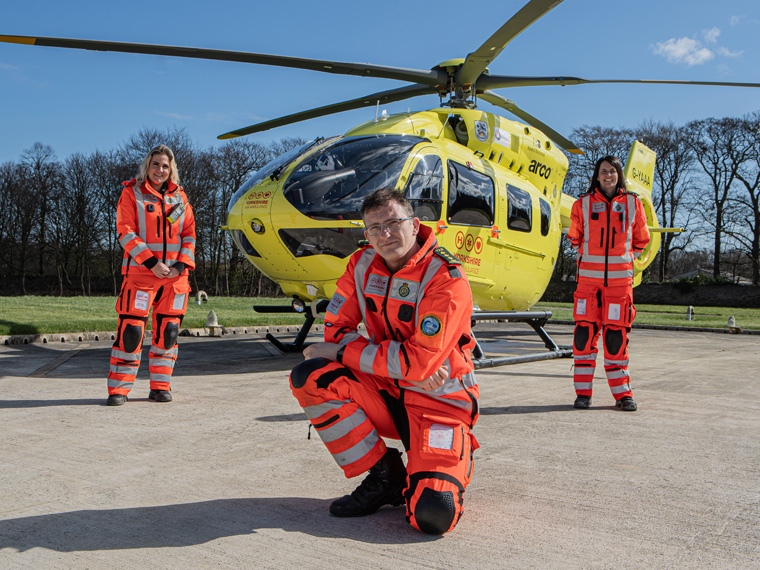

When most of us hear the thrum of the Yorkshire Air Ambulance helicopter overhead, we instinctively glance up. But what’s happening inside that aircraft – and what does it take to keep it ready to fly at a moment’s notice?
In Episode 7 of Summat In t’Air, Jon Mitchell heads to Nostell Airbase to sit down with Chief Pilot Owen McTeggart and fellow pilot Paul Smith for an exclusive look into life at the controls.
It’s a fascinating blend of precision, teamwork and passion – and here’s what we learned.
Listen to the podcast below, and find the readable version just underneath.
The Working Day Begins Before Sunrise
For Chief Pilot Owen, the day starts just before 7 am – long before the first mission of the day. Under strict Civil Aviation Authority regulations, pilots must complete 30 minutes of aviation preparation before they’re legally able to fly.
That includes:
- reviewing weather systems
- checking Notices to Airmen (from drone activity to temporary restrictions)
- inspecting aircraft documentation
- and of course, a full hands-on examination of the helicopter itself.
Every morning, the aircraft goes through what Owen jokingly calls a “mini MOT”. Cowlings are opened, pipes and oils checked, and every component is closely inspected. It’s not glamorous – but it’s essential.
Safety First: Fuel Samples, System Checks and Thorough Testing
One of the most critical daily tasks is sampling fuel from each of the aircraft’s five tanks.
Why? Because even a small amount of water, often caused by condensation, can cause an engine to fail. In a car, that’s an inconvenience. In a helicopter, 1,000 feet above a city, it’s unthinkable.
So pilots flush, test and retest until the fuel is completely clean.
Once the medical and aviation briefings are complete, engines are started and systems put through their paces. Everything is checked, from the autopilot to the night-flying lights, so that when a mission comes in, the crew can launch immediately with full confidence.
It’s all part of making sure the aircraft is ready for Yorkshire at any second.
When Seconds Matter: Airborne in Three Minutes
Despite all the preparation, once the buzzer sounds the countdown begins.
As Paul explains, Yorkshire Air Ambulance crews are typically airborne within about three minutes. That’s from alert to lift-off, an extraordinary turnaround that saves lives every week.
And yes, the backwards take-off isn’t just showing off.
It’s a carefully designed safety profile that ensures the pilots maintain clear visibility of the landing site through a glass panel at their feet. If one engine were to fail, the manoeuvre ensures the aircraft can still safely land or continue flight. Safety is always the priority.
Landing at Busy Hospitals
Each hospital has its own way of activating the helipad depending on its setup.
At Leeds General Infirmary, trained fire crews staff the rooftop helipad, ready for any emergency.
At Hull Royal Infirmary, ground-level security teams ensure the pad is safe to approach.
After landing, the helicopter must cool down for at least a minute, which, with a critically ill patient on board, can feel like an eternity. But it’s vital to protect the engines.
Then the medical team transfers the patient to hospital care, and the aircraft prepares for whatever comes next.
Ready for Re-tasking – Even Before Landing
On the flight back to base, there’s no guarantee the crew are finished for the day.
If fuel levels and medical kit allow, the pilots can be redirected to another mission mid-flight. The newer H145 D3 helicopters carry more fuel, meaning they can often reach more patients without stopping to refuel, shaving precious minutes off response times.
Once back at Nostell, the pilots refuel, complete records and reset the aircraft. Only when the helicopter is ready for the next emergency do they grab a bite to eat… or finish that half-can of pop left behind on the earlier dash.
A Smoother Ride That Saves Lives
The Airbus H145 D3 fleet features five-bladed rotors, and while that might seem like a small detail, Paul explains it makes an enormous difference.
The extra blade:
- reduces vibration
- allows more weight and fuel to be carried
- improves patient comfort during what can be an incredibly painful journey
For a patient with a broken limb, even slight vibration can cause severe discomfort. These latest aircraft are described by Paul as “silky smooth, the smoothest helicopters I’ve ever flown”, and that comfort matters.
Training, Teamwork and Trust
Both Owen and Paul speak passionately about ongoing training, from night-flying with expensive night-vision goggles to simulator sessions in Germany where pilots can practise emergencies that could never be recreated in the real world.
But perhaps the most striking part of the conversation is the teamwork. As Owen reflects, the Yorkshire Air Ambulance team is made up of “alpha males and alpha females, doctors, paramedics, technical crew members and pilots, all leaders in their field. By all logic, it shouldn’t work. But it does. Beautifully. Because everyone is united by a shared goal: giving the people of Yorkshire the best possible chance when the worst happens.”
And Yes, There Are Moments to Enjoy the View
Despite the intensity and seriousness of their work, Paul admits that sometimes he looks out across the hills of Yorkshire and thinks: “Not many people get to do this…it’s amazing.”
And thanks to the dedication of the YAA team, that spectacular view is part of a service that has saved thousands of lives over the last 25 years.